
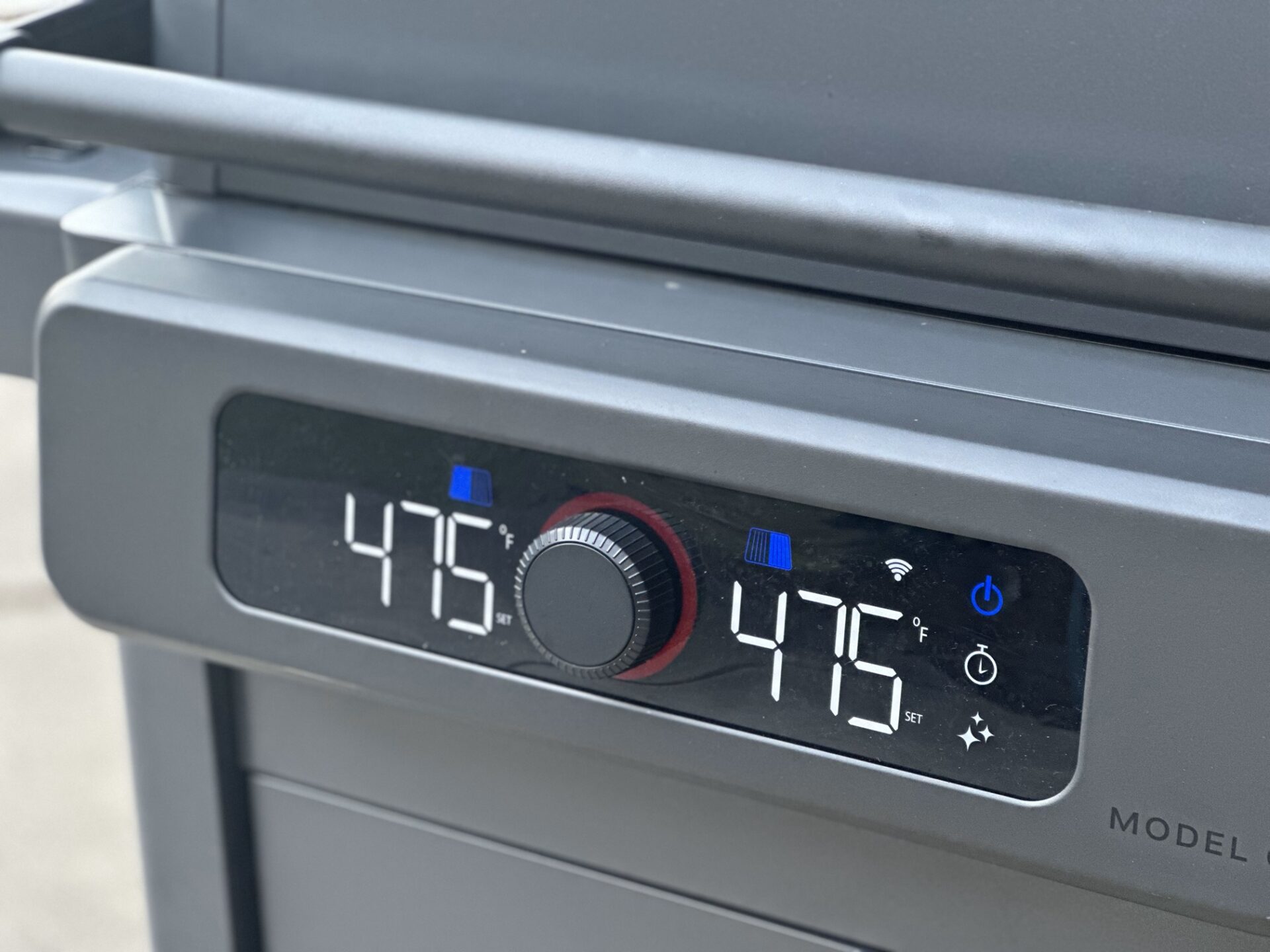

W.C. Bradley Co. is the leader when it comes to electric grill innovation. Their Charbroil brand has a solid electric grill with the EDGE, and their Current Backyard brand is an all-electric brand that leads the space.
All of their electric grills and griddles current have a traditional Calrod setup. There is a heating element underneath the cooking area that converts electrical energy to heat, and cooks your food.
As a leader in the space, they already have a patent for an induction grill. Much like induction stove tops, an induction grill could be a superior technology because it’s much more efficient. It works by using magnetic fields to heat the cooking grate, pot or pan, which has less loss and more control.
W.C. Bradley has filed for another patent that deals with induction. This one is specifically for an induction griddle.
A griddle would be a perfect application for induction technology. They work mostly through conductive heating from the griddle plate, which can be made from ferrous metal to easily allow for the transfer to take place.
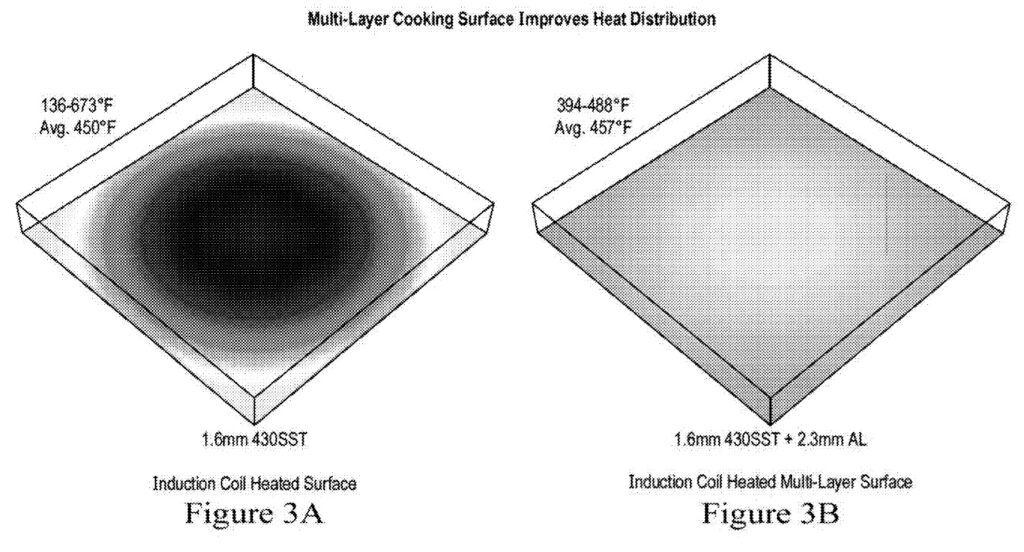
The patent takes it a step further than just a simple griddle too. It shows testing of using a multilayer cooking surface for superior heat distribution. One example shows a ferrous section that’s heated, then another layer that distributes the heat, with a third layer for wear and corrosion resistance.
A purpose of the middle layer(s) is to enhance the heat transfer towards the entire cooking surface and to store a proper amount of heat inertia in the system. Non-ferromagnetic materials with high thermal conductivity such as aluminum and copper can be considered for the middle layer(s). There are other materials such as silver and gold which have high thermal conductivity, but these might not be practical choices for industry.
Pure copper has a thermal conductivity of about 380 to 400 W/m.Math.K and its specific heat is about 390 J/Kg.Math.K. Pure aluminum has a thermal conductivity of about 230 to 240 W/m.Math.K and its specific heat capacity is about 910 J/Kg.Math.K. Aluminum has a density of about 2700 Kg.Math.m.sup.3, while copper density is about 8900 Kg.Math.m.sup.3. In other words, thermal conductivity of copper is about 70% higher than the thermal conductivity of aluminum, while the heat capacity inertia of copper is about 40% higher than the heat capacity inertia for aluminum.
For the middle layer(s), an aluminum plate with a thickness of about 2.6 to 5.2 mm (10- to 4-gauge) can provide a balance between thermal inertia and heat transfer (and temperature distribution) on the one hand, and the time needed to reach desired cooking temperature on the other. In some embodiments, there are multiple middle layers. These may comprise different alloys of aluminum, or combinations of aluminum and copper, to optimize the material and manufacturing as well as thermal performance.
W.C. Bradley Co. patent titled “Induction Griddles”
Using a multi-layer plate gave them less cold spots, and a more uniform temperature across the surface. Their testing showed less of a top end temperature in current configurations, but it’s still enough heat, and a more desirable outcome.
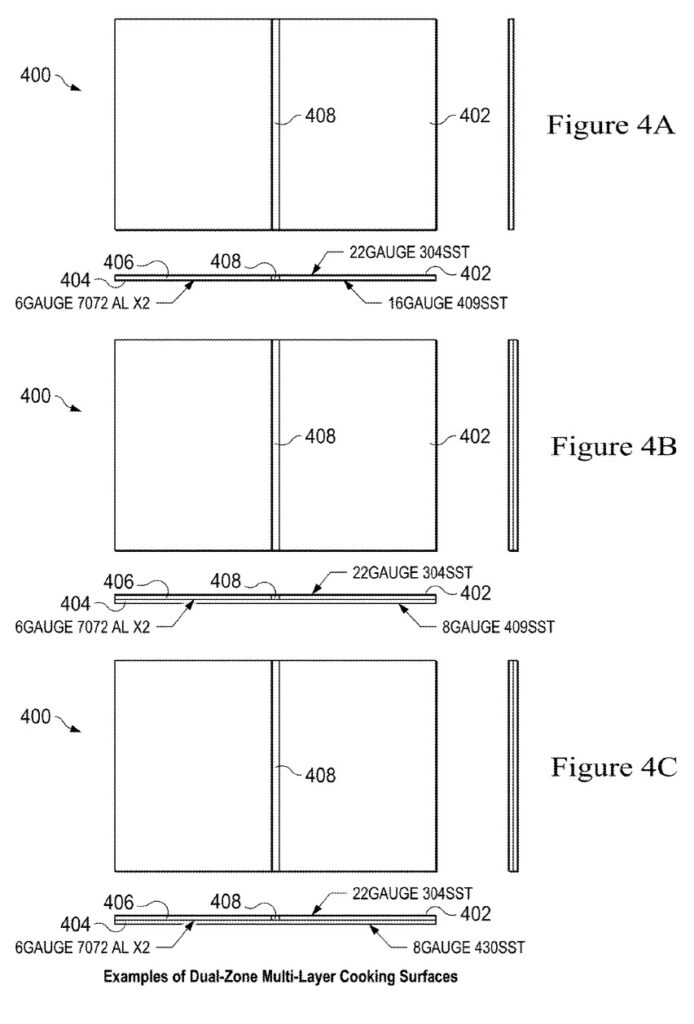
It also shows using a zoned approach too, just like a gas griddle. With cuts or insulated material between the zones on the multilayer surface, it minimizes the heat transfer between zones.
It’s a really innovative approach to taking electric griddles to the next level. The GM of Current Backyard confirmed in our Q&A that they were testing induction technology, so we’ll see if this makes its way to market.