
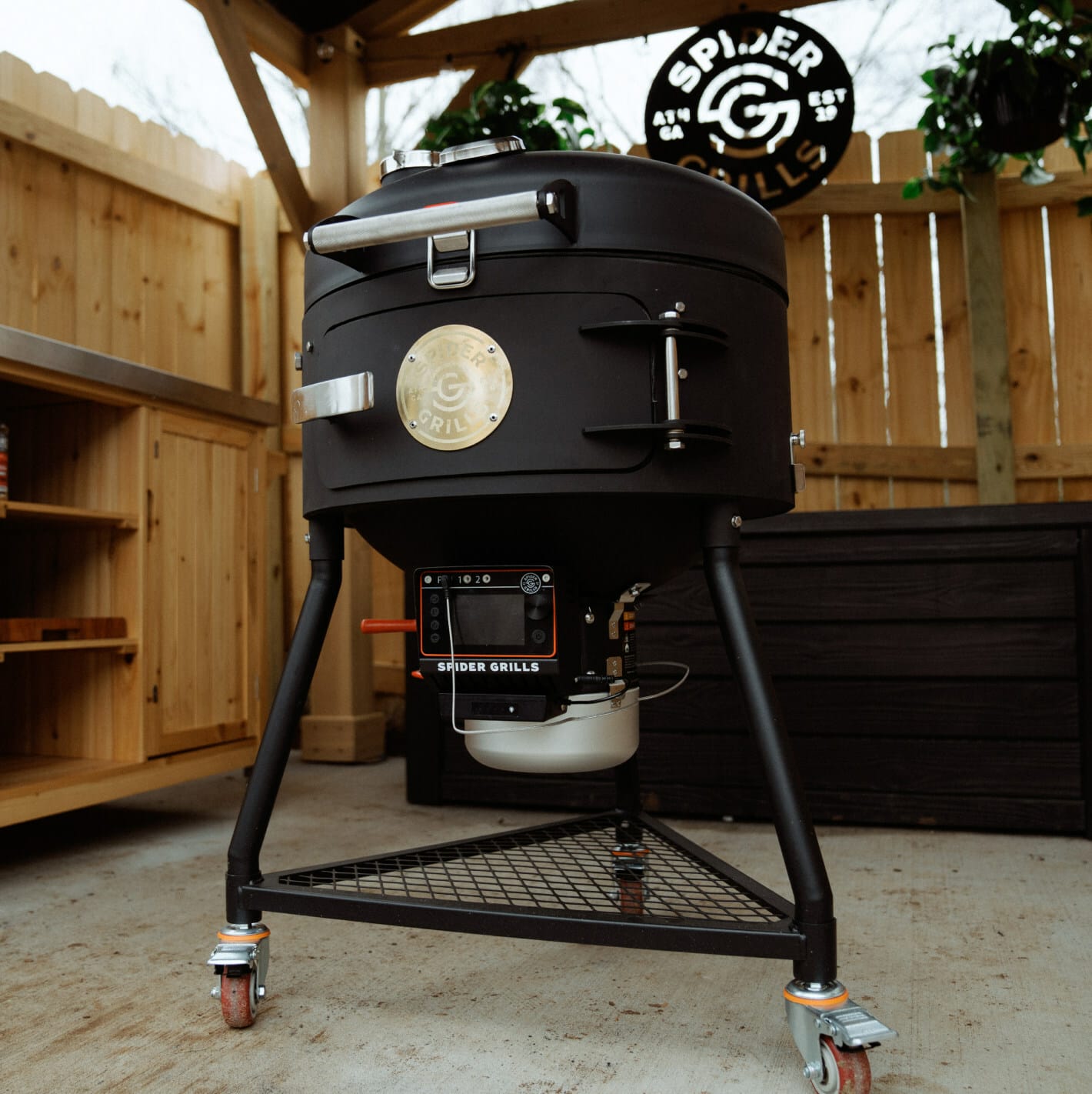

In a backyard category long dominated by gas convenience and legacy brands, Spider Grills is betting that the future of live-fire cooking isn’t less charcoal — it’s smarter charcoal.
Over the past year, outdoor cooking enthusiasts have increasingly discovered Spider’s Huntsman lineup, its expanding Weber kettle accessory ecosystem, and most recently, the larger-format Giant Huntsman. Scroll through social feeds in the live-fire community and you’ll see it: backyard cooks posting briskets, reverse-seared steaks and low-and-slow ribs — often tagged with Spider gear.
So is this surge in awareness organic? Or engineered?
“We’ve definitely seen a noticeable increase in awareness across the Huntsman product line and our Weber kettle accessory ecosystem and a lot of that has come from passionate word of mouth within the live-fire community,” says Bailey Brennan, Director of Marketing at Spider Grills. “Our customers are incredibly engaged and tend to share their cooks, which organically introduces new audiences to the brand.”
But Brennan is quick to clarify: the growth is not accidental.
“Over the last year we’ve been more intentional about storytelling, focusing on education, creator partnerships, and showing how Spider makes charcoal cooking more accessible,” she says. “Our philosophy has always been accessible charcoal cooking, powered by technology, built from durability and defined by real fire flavor, so our marketing leans into empowering cooks with extremely durable products rather than just pushing products.”
That positioning , “accessible charcoal cooking, powered by technology”, may explain why Spider has found traction in a category that can intimidate newcomers. Charcoal promises superior flavor but demands more attention. Spider’s pitch is simple: keep the flavor, reduce the friction.
Growth Fueled By Community And Constraint
Spider’s momentum hasn’t been without growing pains. At points last year, demand outpaced supply.
“We’ve seen major growth over the past year, and it’s been exciting,” Brennan says. “At times last year, our demand even outpaced our ability to keep up with inventory, which showed us just how strong the interest in the brand had become.”
Rather than outsourcing aggressively or cutting corners, the company doubled down on operational control. Its products are manufactured in Vietnam by an American-owned partner and distributed directly from Athens, Georgia.
“One of our biggest priorities is maintaining quality and durability as we grow,” Brennan says. “From day one, the goal has been to create extremely durable, high-quality cookers for people who expect their gear to work as hard as they do.”
That supply chain discipline appears to be paying off. Brennan says improvements in processes have allowed Spider to maintain healthier in-stock inventory levels, a critical advantage in seasonal categories where missed summer demand can’t easily be recovered.
Still, Brennan frames the larger challenge not as logistics, but as product philosophy.
“Beyond production, the real challenge is balancing innovation with simplicity,” she says. “We’re always pushing to make charcoal cooking more approachable through thoughtful design and technology, but every feature has to serve a purpose.”
The Giant Huntsman: Built By Customer Demand
Nowhere is that tension between innovation and simplicity more evident than in the Giant Huntsman, which is a larger, more capable iteration of the company’s original Huntsman platform.
According to Brennan, the product didn’t emerge from an internal brainstorming session. It came directly from the community.
“Consumer feedback was ultimately the number one driving force behind the Giant Huntsman,” she says. “We consistently heard from our community that they loved the integrated, automated kettle technology of the Huntsman, but wanted a larger format that could handle bigger cooks and feed a crowd.”
In other words, customers didn’t want something different. They wanted more of what already worked.
“The Giant Huntsman is essentially a direct response to those conversations. Same philosophy and performance, just scaled up to meet how people actually cook,” Brennan says.
Early feedback has validated the approach.
“Customers appreciate that it delivers more capacity without adding complexity, and that it still feels like a Spider product: durable, intuitive, and built for real-world cooks whether you’re cooking for the family or hosting a full backyard gathering.”
In a category often crowded with feature creep and flashy upgrades, restraint can be a differentiator. The Giant Huntsman adds scale, not complication — a subtle but important distinction.
Direct-To-Consumer… For Now
Despite its growth, Spider has not rushed into broad retail distribution. The company remains primarily direct-to-consumer, a decision Brennan says is deliberate.
“Right now, direct-to-consumer remains a major focus because it allows us to prioritize customer service, product education, and ongoing support throughout the ownership experience,” she explains. “Selling directly gives us the opportunity to connect with customers, answer questions, and make sure they feel confident cooking with charcoal from day one.”
That emphasis on education aligns with the brand’s accessibility narrative. If charcoal cooking feels intimidating, Spider’s competitive edge isn’t just hardware — it’s guidance.
Still, Brennan leaves the door open to expansion.
“We’re always exploring strategic retail partnerships that align with the brand and help us reach new audiences in the right way,” she says. “Our approach is less about rapid expansion and more about finding partners who understand the live-fire category and can tell the Spider story authentically.”
In other words, distribution will follow brand integrity — not the other way around.
The Road Ahead: Ecosystem Over One-Off Products
If the Giant Huntsman represents scale, the future appears to represent breadth.
“Our roadmap is centered around making charcoal cooking feel less intimidating and more versatile,” Brennan says. “That means continuing to innovate around smart technology, modular accessories, and durable cookers that deliver real fire flavor without unnecessary complexity.”
Expect expansion of the ecosystem — particularly accessories designed to unlock more versatility from grills customers already own.
“You’ll likely see us keep expanding the ecosystem — especially with new accessories designed to unlock even more cooking versatility and help people get more out of the grills they already own,” Brennan says.
Beyond hardware, Spider is investing in educational content, collaborations and community-driven experiences — effectively turning its customers into both users and evangelists.
“If you’re a Spider fan, the goal is simple,” Brennan says. “More ways to cook, more ways to customize your setup, and more reasons to fire it up year-round.”
A Tech Mindset In A Traditional Category
What makes Spider Grills noteworthy isn’t just growth. It’s the mindset behind it.
In an era when many consumers are rediscovering analog experiences — vinyl records, film cameras, wood-fired ovens — Spider isn’t replacing tradition. It’s augmenting it.
Charcoal cooking, historically seen as labor-intensive, is being reframed as both authentic and approachable. Technology doesn’t replace the fire. It refines the experience.
And as backyard cooking continues to evolve into year-round, community-centered entertainment, brands that combine durability, education and ecosystem thinking may be best positioned to win.
Spider Grills appears intent on being one of them — not by chasing every trend, but by listening carefully to the cooks already gathered around the flame.