
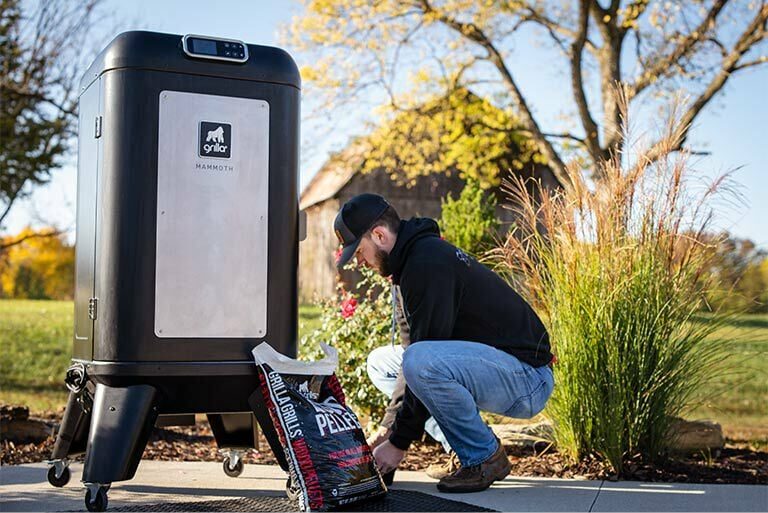

American Outdoor Brands (AOUT), the parent company of Grilla Grills, reported a significant decline in sales for their fiscal 2026 that ended April 30th. Things aren’t quite as rough as they seem on face value though, their 14.3% sales decline was impacted by retailer pull-ahead before tariffs kicked in last year.
On an adjusted basis, they saw a 5.4% sales decline year-over-year. That’s still not what you want to see, but also not surprising given all of the headwinds outdoor brands have had.
To normalize for changes in retailer inventory levels and to give more real-time consumer data, AOUT also reports their POS sales data. AOUT buckets Grilla Grills into their Growth Brands, and that particular group saw adjusted sales improvements and positive POS comps.
You’ll recall that last quarter, we defined these key growth brands as BOG, BUBBA, Caldwell, Grilla and MEAT! Your Maker. On a combined basis and again, adjusting for the acceleration, this group delivered positive year-over-year net sales growth as well as positive POS growth for fiscal 2026.
This is a great result because what matters most is what happens when consumers encounter our brands at retail and our POS results tell us that consumer demand for our products remained healthy throughout fiscal 2026. We delivered POS growth of approximately 4%, representing our fourth consecutive quarter of positive year-over-year POS growth.
Brian Murphy, President and CEO of AOUT
Tariffs Make Comps Difficult
For the next year, it’s going to be difficult to decipher operating results at all companies because of the tariffs. It will skew results in two ways.
The first is just like what was described above for pull-ahead purchases. It’s especially noticeable at AOUT because they don’t operate on a calendar year, so any pull-ahead then subsequent lag is going to span different years, rather than quarters. Quarter-over-quarter comps will be skewed at other companies.
The other area that you’ll see difficulty with interpreting financials is the treatment of tariff refunds. It seems like every company is accounting for refunds a little different. Some are taking expected refunds in the year to the P&L, others are booking it as a receivable and taking it when their inventory moves to the balance sheet. This can skew gross margin numbers positively on the go-forward.
Now speaking to the topic of tariffs. Following the Supreme Court’s February 2026 ruling that IEPA-based tariffs were unlawfully imposed, we have taken the steps to file for a refund of duties paid under those tariff orders. In Q4 of fiscal 2026, we filed a refund claim related to IEPA tariffs in the amount of $15.2 million, and we recorded a receivable for refund in other current assets. Of that $15.2 million, we reduced our inventory carrying value by $10.8 million and the balance of the $4.4 million reduced our cost of goods sold to offset IEPA tariffs amortized in Q3 and Q4.
Andy Fulmer, CFO of AOUT
For AOUT, it also didn’t seem like anticipated much of a positive cash impact from their tariff refund. They talked about other tariffs impacting their balance sheet that would offset the refund and possible the positive margin impact they receive. Other outdoor brands seemed to talk about the refund as a pure positive to gross margin and cash.
So the way that we’re thinking about the refund is overall, the refund is really offsetting in many ways, the residual tariff burden from the replacement tariffs, right? Section 122, although it’s temporary, Section 232 on steel and aluminum, TBD on 301, if there are going to be additional changes there. So we don’t view the tariff refund as a discrete windfall in any sort of way. We really see it as a way to offset some of these other costs that have crept in throughout the year. We’ll also just be more disciplined on OpEx so we can maintain that long-term model that Andy alluded to.
And then — but look, if there — we don’t know the timing of when we’re going to receive these things. I think most people expected it would take a while. In reality, we started getting some refunds sooner than we expected, right? So timing is unknown overall, but let’s just assume that they come sooner, right? What would we do? First, we would look to offset any additional costs because that’s a real factor.
Brian Murphy, President and CEO of AOUT
Acquisitions
AOUT has grown their portfolio through acquisition, so naturally it’s also a part of their future roadmap. They hired a head of corporate development a couple months ago to focus on inorganic growth. They continually reinforce that they lead with innovation but they talked about how acquisitions fit into that strategy.
When it comes to — kind of alluded to buy versus build is when Tyler first came here in the last month or so, last 2 months, the first thing we did as a team was sit down and this includes the entire executive team and getting him up to speed on our philosophy because at the end of the day, innovation is probably getting tired of us talking about it, but that is what we do. That’s who we are. And that leads everything, right? So even when we look at acquisitions, we look at it through the lens of innovation. Is there a brand here that has a, I think, highly enthusiastic base of consumers that we can tap into. Do they have a strong brand? And ultimately, does this become a vessel for us to now insert some of our new innovation. We’ve got tons of new products that we’ve created and ideas that we believe we don’t have the right brand today. And ultimately, that helps give Tyler and our team a road map for these are the brands that we believe are going to be the most strategic for us.
Brian Murphy, President and CEO of AOUT
Will AOUT Split?
AOUT is very similar in design and history as the former Vista Outdoor. They were both spun-off and had ammunition and outdoor lifestyle brands. Then, they both added new brands through acquisition as they continued to grow. The CEO and other leadership of AOUT even came from Vista Outdoor.
Vista Outdoor eventually determined that it was better for shareholder value to split into two separate companies. The two arms had different earnings profiles and received different valuations.
While AOUT is currently smaller that Vista Outdoor was, I can’t help but wonder if they’re on the same path. They have never said anything to imply that, it’s just pure speculation.
Our Outdoor Lifestyle category, which consists of products relating to hunting, fishing, meat processing, outdoor cooking and rugged outdoor activities represented approximately 58% of fiscal 2026 net sales, up from 46% at our spin-off in fiscal 2020. This evolution reflects our focus on large, attractive outdoor recreation markets where innovation can drive consumer engagement, distribution expansion and long-term growth. Our Outdoor Lifestyle net sales for the fiscal year decreased 13.1% compared to last year. Adjusting for the acceleration [from tariffs], net sales in Outdoor Lifestyle decreased 1.6%.
In our Shooting Sports category, which includes solutions for target shooting, aiming, safe storage, cleaning and maintenance and personal protection, net sales for the year declined 15.9% compared to last year, driven mainly by a decrease in aiming solutions. Adjusting for the acceleration, Shooting Sports net sales declined by 10.4%.
Andy Fulmer, CFO of AOUT
AOUT probably has some runway to grow but at some point investors might think that the overall value of the company is being hurt by one half lagging the other. It could net a better return to sell one side to deploy the capital in the other.