

It’s no secret that most of grill manufacturing is done in Asia. With all of the tariff rumors lately the industry has been holding their breath and strategizing how to deal with any tariffs.
Now that there’s possibly more certainty around it, the overall exposure is worse than I think many companies anticipated. The early reaction is they’re raising prices and possibly reducing features to maintain price points.
Price Increases
Even before the tariffs were officially announced with the chart that had the amount by country, brands started laying the groundwork for price increases. Notices were put out for two brands to buy before tariff induced price increases.
The first came from Z-Grills, which has a business model that their grills are cheaper because they own the manufacturing. They’ve even gone as far as offering a buy 1 grill get 10 free promotion.
They do their manufacturing in China, which leaves them very exposed to high tariffs. They sent out an email last weekend to buy ahead of price increases coming.

The other brand that may be planning price increases is Weber. They do 55% of their manufacturing in the US, with the balance done in both China and Taiwan. China may have the highest tariff percentage with different news outlets reporting numbers as high as in the 70s once you include previous tariffs to the reciprocal tariffs.
Taiwan was often thought as a safe place for brands to diversify their manufacturing to avoid tariffs on China. There isn’t really anywhere to hide in Asia though, with tariffs announced at 32% on Taiwan.
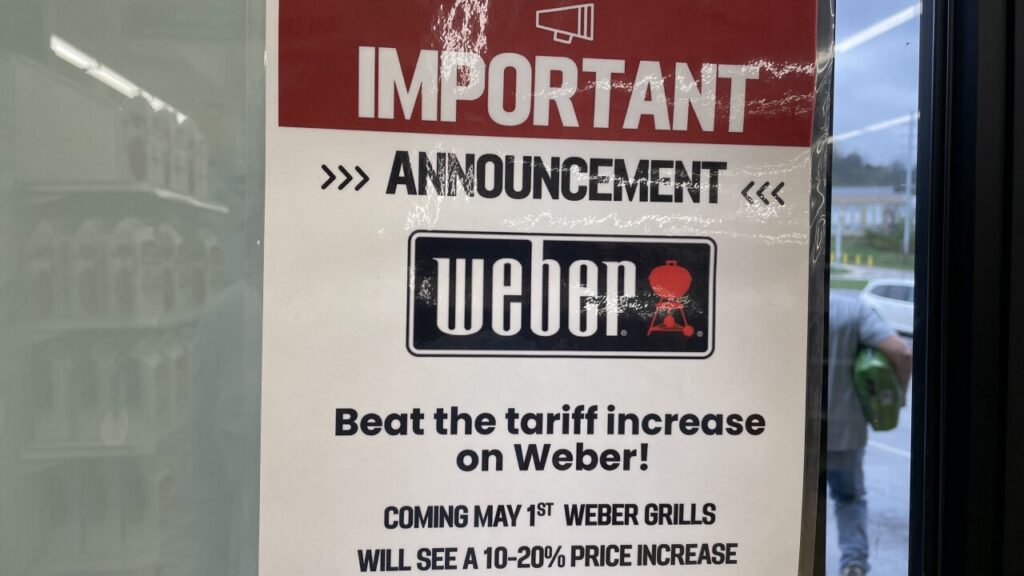
Even before the reciprocal tariff amounts were announced, there were signs popping up at some Ace Hardware locations that tariff pricing was coming into effect for Weber on May 1st. It’s unclear if that advertising came from Weber or how any possible price increases were communicated to retailers.
Traeger Exposure
Like most companies, I would guess that Traeger was surprised by the high level of tariffs imposed on countries outside of China. In their 3rd quarter 2024 earnings call they described their supply chain.
So first of all, let me provide just some general information on state of play in terms of where we manufacture and where we may have risk. About 80% of Grills are manufactured in China, about 20% are manufactured in Vietnam. Currently, Wood Pellet Grill is not included on the import code from — in terms of tariffs.
So although we have exposure to China, tariffs were assessed only on our accessories and not on our Grills. With that said, we have been — we’ve been thinking about diversification for some period of time. Again, 20% produced in Vietnam, although we’re in the process of adding a very large new manufacturing partner in Vietnam that has the ability to scale meaningfully. And so the 20% is certainly a backward-looking number and not a forward-looking number based on the capacity that we’ll have.
If you go beyond Grills, they said accessories, nonmeter accessories are largely manufactured in China. We’re currently assessed the tariff on those. Meater is produced entirely in Taiwan and our consumables are produced here in the U.S. There’s a lot of chatter on tariffs right now.
And I think it’s going to take a little bit of time to sort out exactly the new administration strategy on tariffs, timing, magnitude of those tariffs. But I would say that we have been building optionality around — in our sourcing model. We’ve been diversified, not just in Vietnam. We’re looking closely at other manufacturing options in Asia.
We’ve been working on Mexico as a long-term geography in which to manufacture. And although the U.S. is not a viable manufacturing source given a number of the dynamics of the category. We feel like we have built a fair bit of optionality with the partnerships that we either have in place or they were in the process of building.
And with that optionality, we think we have the ability to react reasonably quickly and reasonably efficiently to how tariffs evolve. And so I think we’re well-positioned to do the best thing for the business. We won’t be reactive. We’ve been very proactive in this process.
And as we understand the shifting landscape, we will make decisions accordingly. And of course, when tariffs are assessed. And to the extent that they are assessed across geographic sourcing locations, we will work closely with our manufacturers to become more efficient. To figure out how we can share in those tariffs.
And pricing is always a lever. And I suspect that an environment where tariffs are broad-based and pervasive that that most brands will also be leading to price to mitigate the downside of those tariffs, and we would look to do the same.
Jeremy Andrus, CEO of Traeger – Q3 2024 Earnings Call
I infer from Jeremy Andrus’ commentary they Traeger viewed Vietnam, Taiwan and other Asian countries as being more insulated from tariffs. I covered Taiwan tariffs with Weber, but Vietnam’s had one of the highest tariffs imposed at 46%.
I’m not sure what other Asian countries they were eyeing expanding to, but I know other brands they were working on manufacturing in Thailand. Unfortunately, for any brand looking to Thailand for tariff avoidance, Thailand still received a high tariff amount at 36%.
Solo Stove
Solo Stove was already facing major existential problems prior to the tariff announcement. They noted that bankruptcy is on the table for them as they have some liquidity issues. The amount of the tariff could only exacerbate those problems. They described their supply chain as follows in their 2024 10-K filing.
The majority of our fire pits, our highest grossing product, are currently made by two manufacturers in China, with additional limited production in China, India and Vietnam. As a result of this concentration in our supply chain, our business and operations would be negatively affected if our key manufacturer or suppliers were to experience significant disruption affecting the price, quality, availability, or timely delivery of products or were to refuse to supply us.
Solo Brands 2024 10-K SEC Filing
To go along with their issues with liquidity they now face massive tariffs where they produce their most revenue producing products. Without any great Asian options to flex their supply chain to, and limited resources to do it, they must be facing some tough decisions. Their stock is down to $0.14 off the tariff news.
Lowering Specs
While it’s obvious to run to price all along the value chain to deal with tariffs, there’s another option that brands are looking at. An industry source said that some grill brands are looking to spec down their products to maintain price points.
An example of this is if they always offer an entry charcoal grill at $99, they still offer a charcoal grill at that price point but remove the ash pan, handles, and wheels. That lowers the production cost to bring back some of the margin lost by the tariffs.